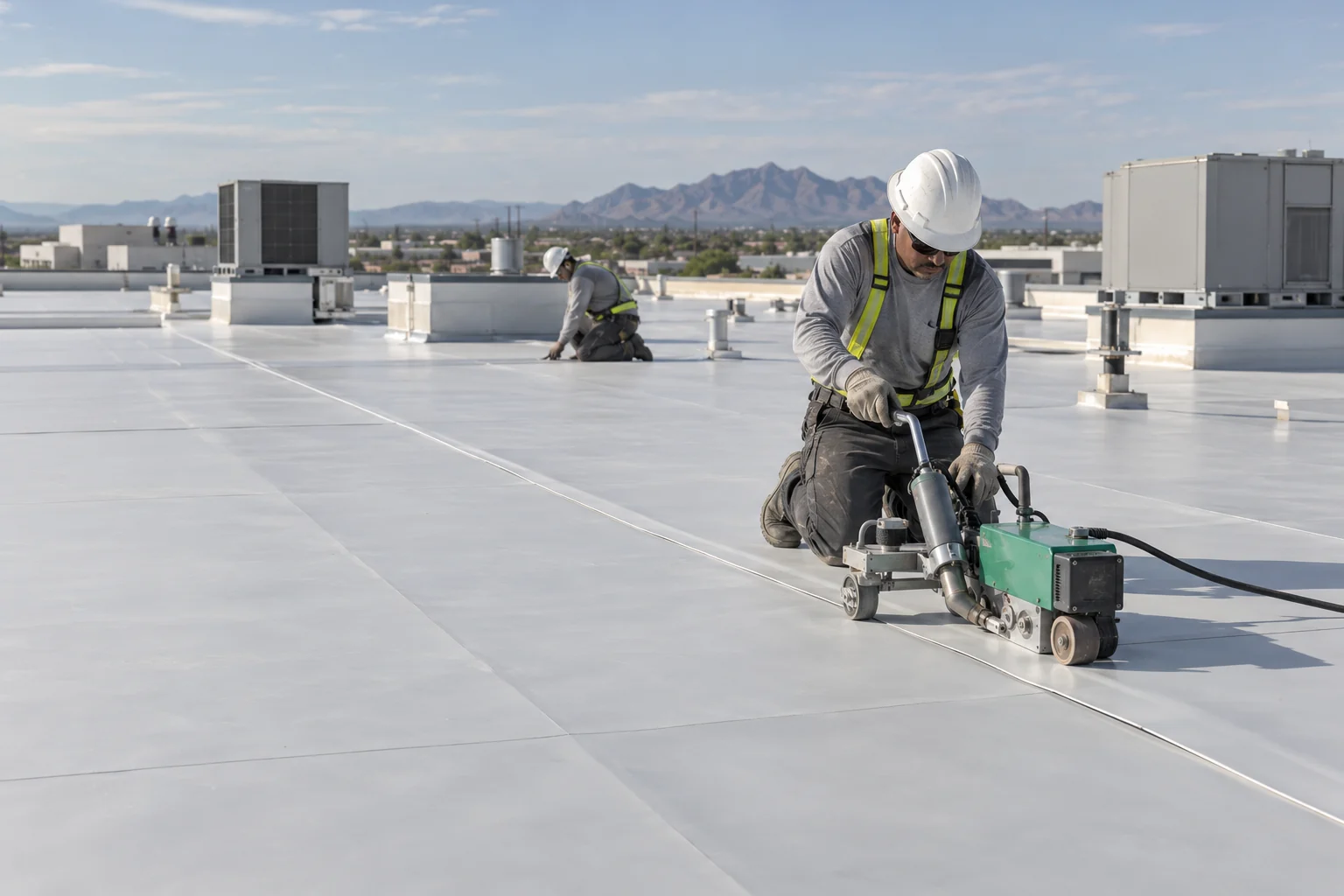
Select Work For The Existing Assembly
The first step is identifying the roof and the condition of its components. A membrane may have a repairable defect while the supporting layers remain serviceable. A metal roof may need a connection repaired rather than broad replacement. The assessment distinguishes those situations.
Where a roof includes additions or different materials, the transitions matter. Previous patches and equipment changes can affect how new work connects. A practical scope accounts for the assembly at the repair location rather than assuming every section is identical.
Coordinate Access And Building Activity
Some commercial properties have controlled access or operating requirements that influence roof work. Tell us what applies to your building before the assessment. Proximity to Falcon Field does not establish that the property has aviation operations, specialized permissions or a particular construction type.
Access planning includes equipment, material handling and the spaces below. The work sequence should consider those needs alongside roofing requirements. No uninterrupted-operation promise should be assumed before the actual scope is reviewed.
Assess Metal Roofing Connections
If the building has metal panels, we inspect laps, attachment, penetrations and signs of deterioration. A worn finish may be suitable for restoration after preparation, but severely weakened metal requires another remedy. Coating is not a replacement for panel strength.
Fastener and flashing repairs should address the underlying connection. Covering a loose component with sealant can leave its movement unresolved. The appropriate repair depends on the panel system and the surrounding condition.
Assess Low-Slope Membrane Systems
TPO, PVC and EPDM require compatible repairs specific to their material. Surface appearance alone is not enough to identify the system. Weathered membrane and previous patches may require preparation before a new connection can be made.
Seams, drains and equipment curbs receive attention alongside the field membrane. A localized defect may allow a localized repair, but suspected moisture below the surface can require further investigation and removal of affected material.
Choose Repair, Restoration Or Replacement
Repair suits a defined defect when the roof can support the work. Restoration may suit a compatible assembly after preparation. Replacement becomes a different consideration when retained material is no longer suitable or the building requires a more substantial change.
These choices should be based on findings rather than a preset preference. A roof’s age alone cannot establish the answer, and a recent leak does not prove every section is damaged. The extent and cause of the problem matter.
Coordinate Future Rooftop Work
Equipment replacement and new supports can affect a roofing project. If such changes are planned, include them in the initial discussion. The roofing details should be completed as part of the assembly rather than improvised after a finished surface is cut.
Service routes also matter after the work. Routine access should avoid unnecessary damage, and new penetrations should use suitable details. A sound roof can be compromised by unrelated work that does not account for its system.
Questions For Facility Managers
Can an unknown membrane be assessed? Yes; provide existing information if available, but do not guess. Is one patch enough for recurring leaks? Only investigation can establish whether the source is localized or broader. Can roof work be coordinated with operations? The actual access and operating requirements should guide planning.
An estimate request is most useful when it identifies the property, the symptom or planned work and any constraints. It should not require the facility manager to diagnose hidden conditions before asking for a roof assessment.
Consider The Next Equipment Change
If a rooftop unit will be replaced, its size, support and opening may affect the roofing detail. Planning the roof and equipment work together helps avoid repairing an area that will soon be disturbed. The connection should suit the system, whether membrane or metal.
Even when equipment stays, access routes can affect the completed roof. Regular service should account for surface protection and the locations of sensitive details. A roof is not automatically suitable for unrestricted traffic simply because it is accessible.
The building operator can identify known work and access needs during the assessment. The roofing scope can then consider the relevant transitions and protection rather than treating the project as only a surface installation.
If future requirements are uncertain, the current work should still address the roof’s actual condition. It should not assume an unconfirmed equipment project or add unnecessary scope. The goal is coordination of known needs and a sound completed assembly that can be maintained appropriately.
Get An Estimate
Use the request form for your commercial property in the Falcon Field employment area. This is a Mesa service area, not a claim of airport affiliation or a separate office. The assessment establishes system-specific roofing work and the information needed for a firm quote.