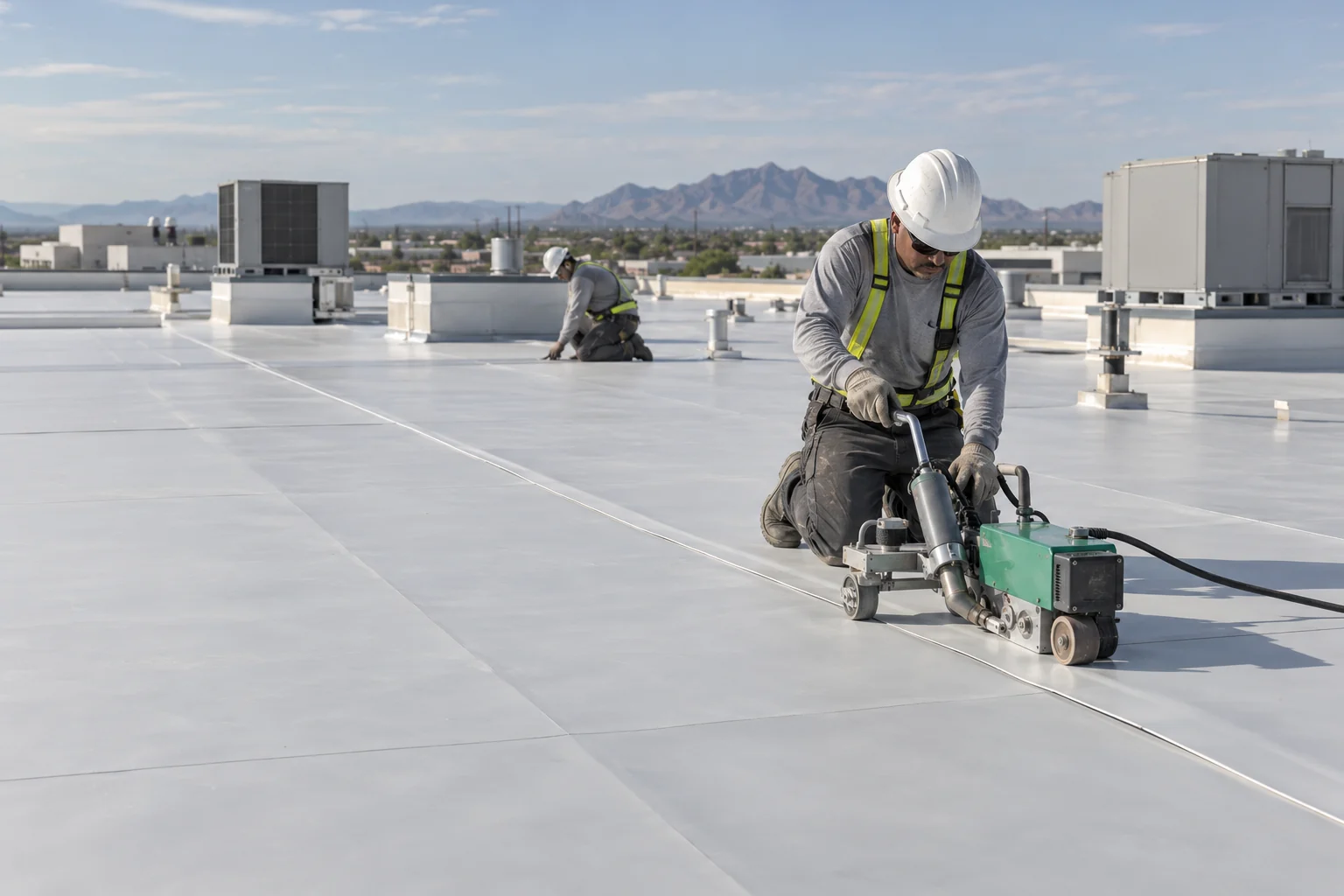
Identify The Existing Membrane
TPO is a thermoplastic single-ply roofing material. White roof surfaces can look similar from a distance, so material identification matters before repair products are selected. Existing information and the roof assessment help establish which system is present.
A roof may also contain patches or added sections made from different products. Those transitions deserve attention because a repair needs compatibility with the actual material at the work area.
Assess Seams And Flashings
TPO systems rely on properly completed seams and details. Open laps, damaged flashings and punctures can create a repair scope when surrounding material remains suitable. Weathered or contaminated surfaces need appropriate preparation before repair.
Equipment curbs, drains, corners and perimeter transitions are examined alongside the membrane field. A leak near an air-conditioning unit may involve the roof detail, the equipment or another source; inspection should distinguish those possibilities.
Look Below The Surface When Needed
A membrane repair is not enough if material underneath is wet or unstable. Where moisture is suspected, additional investigation helps define the affected area. Limited damage may be removed and repaired without replacing every roof section.
For a replacement project, the condition of insulation, deck and attachment affects the assembly choice. Covering existing roofing is not automatically suitable just because another layer can physically fit.
Plan The Complete Assembly
For a replacement project, the membrane choice is only one decision. The existing deck, insulation, attachment and drainage influence what the new assembly needs. Material that is wet or unstable may require removal rather than being retained beneath a new surface. The assessment establishes the conditions before the work is defined.
A roof with several sections may not have the same needs everywhere. One area may have different insulation or prior repairs, while another may connect to a wall or addition in a different way. Those conditions should be considered at the transitions, not averaged into one assumption for the entire building.
Rooftop equipment also affects the scope. Existing curbs and penetrations need compatible details, and known future changes should be coordinated with the roofing work. A newly completed membrane can be compromised by a later opening that is not integrated with the assembly.
For repair work, the same principle applies on a smaller scale. A patch should connect to sound membrane and account for the material beneath. Its size follows the defect and surrounding condition rather than simply the smallest visible opening.
Drainage remains a separate requirement. A membrane can provide a protective surface without correcting an obstruction or a low area. If water remains on the roof, the reason should be assessed before assuming a new TPO surface solves it.
Questions About TPO Roofing Work
Can a weathered TPO roof be repaired? It may be repairable when the surrounding material can be prepared and connected using an appropriate method. Surface condition and compatibility need evaluation; a general description of the membrane does not establish the condition of a particular roof.
Is a seam defect always a small repair? The visible opening may be limited, but adjacent membrane or concealed layers may also be affected. Investigation establishes the boundary. A local repair can remain practical without assuming that every defect is confined to the first visible gap.
Can the existing insulation stay during replacement? Only where the planned assembly and condition allow it. Suspected moisture or damaged material needs evaluation. Retaining unsuitable layers to avoid removal can undermine the purpose of the new roof.
Does a white membrane guarantee a particular energy saving? No. Building performance depends on insulation, equipment and other conditions. The roofing decision should not rely on an unsupported savings percentage or a promise based only on color.
What if the building needs to remain occupied? Operating requirements should be discussed before the sequence is established. Access, equipment and the spaces below affect planning. The specific scope determines practical arrangements; no universal promise of uninterrupted operation should be assumed.
How should future repairs be handled? Use materials and methods compatible with the existing system. An unrelated patch can complicate later work. Identify the roof to anyone planning penetrations or equipment changes so the roofing detail remains part of the project.
Plan For The Building
Rooftop service routes and future equipment changes should be considered in the roofing scope. Access protection and properly integrated penetrations help the completed roof remain serviceable. Building operations influence staging and work sequence.
Get An Estimate with the commercial property location and your reason for considering TPO work. We use the roof condition and project requirements to establish a meaningful scope.
For a building with several roof levels, identify the affected section when requesting work. Different sections may have different systems and access requirements.