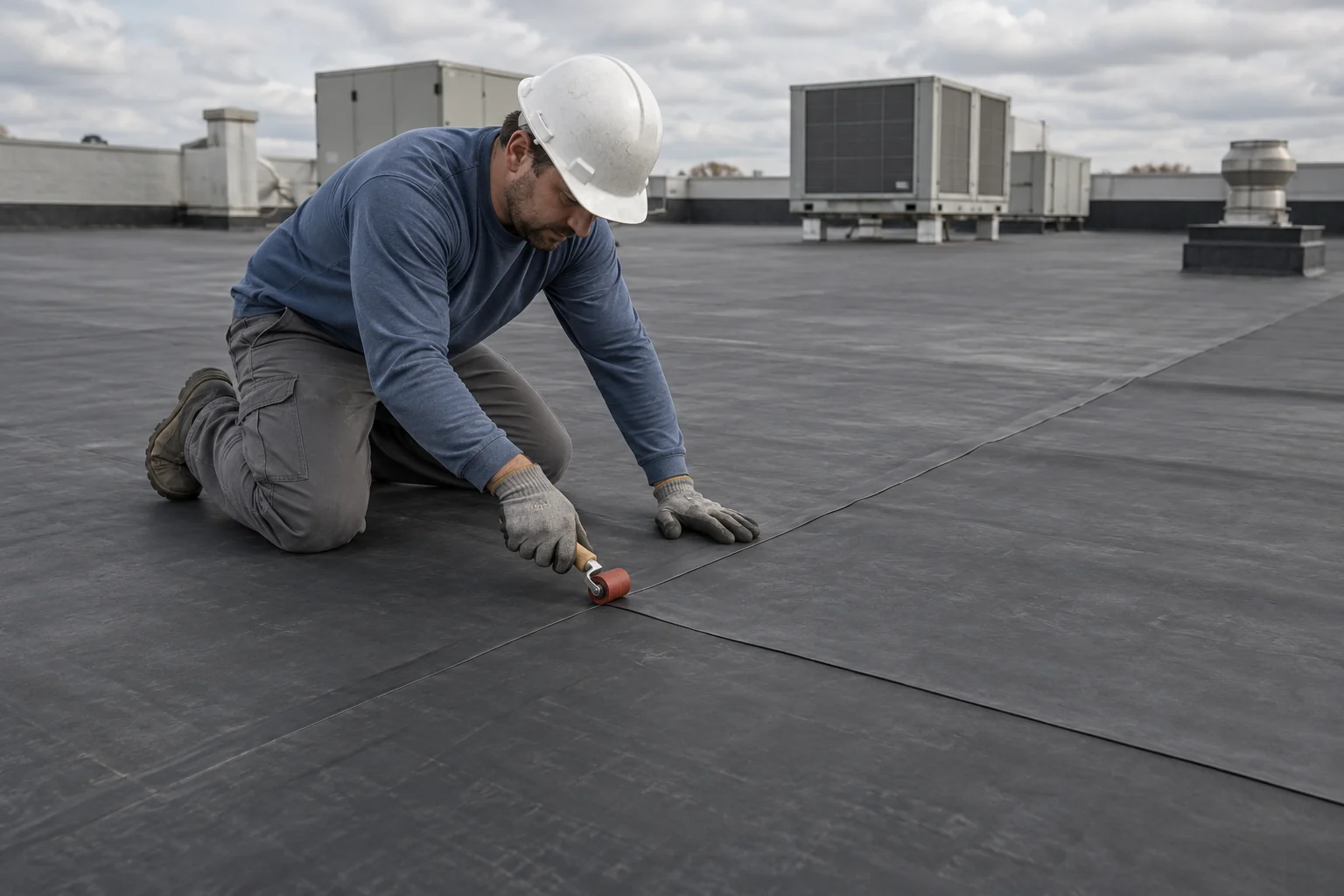
Roofing Above Occupied Commercial Space
If several occupants share a building, a roof problem may not follow the unit boundaries below. The drainage area, equipment and construction can connect spaces in different ways. Describe where the problem appears so the assessment can relate it to the actual roof.
Work planning should consider access, occupied areas and equipment servicing. These requirements differ by property. A district location does not establish that every building needs the same schedule, staging arrangement or roof system.
TPO, EPDM, PVC And Metal Roofing
We offer services for these four commercial roofing families. Each has its own materials and detail methods. TPO and PVC may look similar but require compatible system-specific work. EPDM has a different repair approach, while metal roofing depends on panels and their connections.
Existing patches and additions can create further differences within one roof. Material identification helps avoid applying a repair intended for one system to another surface. The scope should reflect what is actually present at the work area.
Investigate Leaks Before Expanding The Scope
A ceiling stain or drip indicates a need for assessment, but water may travel before appearing inside. We inspect the relevant roof surface, nearby details and drainage rather than assume the entry point lies directly above the symptom.
A defined defect can be repairable when surrounding material is suitable. If water has affected insulation or another layer, the repair may need localized removal. The inspection establishes whether a focused scope is practical or additional investigation is necessary.
Evaluate Restoration Opportunities
A sound compatible roof may be restored after repairs and preparation. Retaining useful material can reduce removal, but coating or another surface renewal cannot make wet or unstable layers suitable. Restoration eligibility requires evaluation of the whole retained assembly.
Previous coating and repair materials matter because a new system must connect to them or they must be addressed. A smooth appearance is not proof of adhesion, and a reflective color alone is not a performance specification.
Plan Replacement When It Is Appropriate
Where material has deteriorated too broadly to support the intended work, replacement may be the practical direction. The new scope should consider insulation, attachment, drainage and details in addition to the visible membrane or panel.
The building’s upcoming needs also belong in the discussion. If equipment will change or roof access must accommodate regular service, those details should be coordinated. A replacement should not be planned in isolation from known work that will immediately affect it.
Review Drainage And Transitions
Outlets, walls, edges and equipment curbs connect to the field roof in different ways. Their condition can determine the repair even when the broad surface remains sound. A large field patch is not always the correct response to a failed transition.
Persistent water needs its own assessment. Clearing an obstruction differs from repairing a drain connection or correcting a low area. The roofing scope should identify the cause rather than assume any new surface resolves drainage.
Questions From Property Managers
Can the building stay occupied? That depends on the work and operating requirements and should be reviewed during planning. Can one roof section be addressed? Potentially, when its boundaries and connections allow it. Is roof area enough for a price? No; it does not describe material, damage or access.
Start with the commercial address and the work that prompted the request. Include restrictions or sensitive areas, and state when the roof material is unknown. This information supports a useful assessment without requiring a technical diagnosis.
Assess Shared Roof Sections Carefully
A commercial building can contain spaces with different uses beneath one roof. A repair area should be defined by the roof’s construction and condition rather than by the lease line below it. Water pathways, equipment curbs and drainage can cross those interior boundaries.
This matters when a recurring symptom seems isolated to one occupant. The assessment may need to examine a larger roof area to identify the source, even if the final repair remains small. Investigation area and repair area are not necessarily the same.
If the property has several access points or equipment responsibilities, describe them when requesting work. The purpose is to arrange a practical assessment and avoid overlooking a relevant detail because it sits above another space.
The final roofing choice still depends on material and condition. A shared roof can support localized repair when suitable, and a standalone unit can require broader work when its assembly is deteriorated. Building organization is part of planning; it is not a substitute for roof evidence.
Get An Estimate
Fiesta District is part of Mesa. Use the roofing request form to begin a project-specific discussion for your building. Inspection establishes the appropriate repair, restoration or replacement scope before a meaningful quote is prepared.