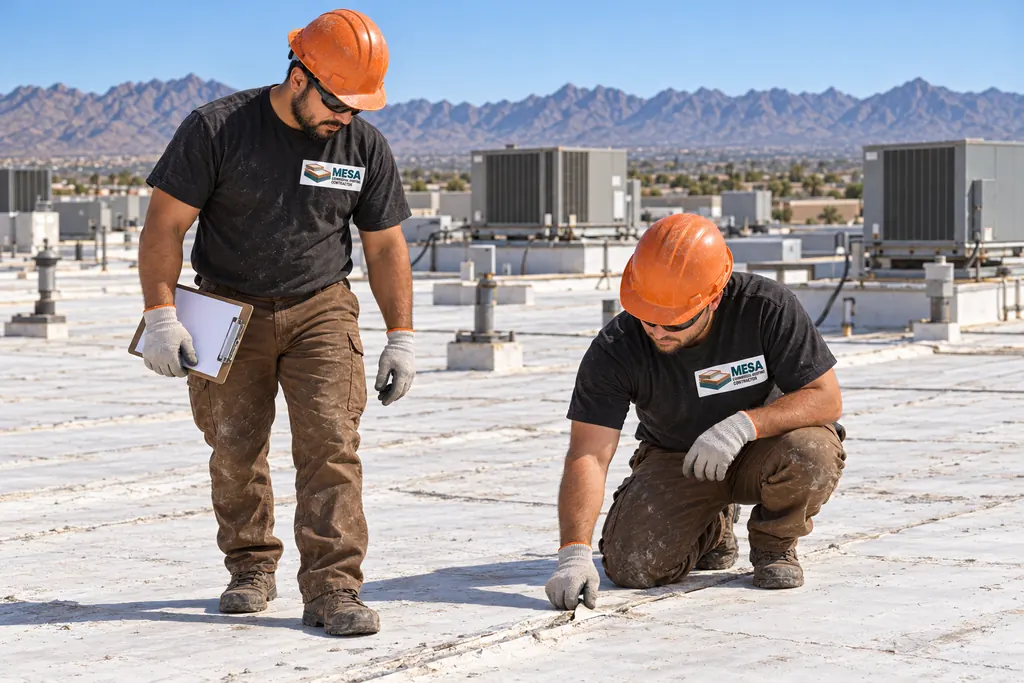
Two roofers walking a membrane roof with a clipboard, one checking a seam

Mesa Commercial Roofing Contractor

We install, replace, and repair TPO, EPDM, industrial, and metal roofs for Mesa building owners and facility managers, starting with an inspection of the roof you have now.

  • TPO, EPDM, And Metal Systems
  • Moisture Checked Before Any Decision
  • Opened Sections Dried In Daily
  • Mesa Plus Seven Nearby Areas

Roof Systems

TPO, EPDM, Industrial, And Metal Roofs In Mesa

As a Mesa commercial roofing contractor, we work on four roof systems. Each card shows what sits under the surface, because the deck and insulation matter as much as the membrane.

Welded seamWhite TPOCover boardInsulationSteel deck

TPO Roofing

White TPO sheet with hot-air welded seams, laid over insulation on low-slope retail, office, and warehouse roofs. The welds and the flashing at HVAC curbs carry most of the load, so we check both closely.

Best For

  • Low-slope roofs over cooled space
  • Roofs crowded with rooftop units

Watch For

  • Wet or crushed insulation board
  • Open welds at curbs and corners
TPO Roofing in Mesa
Pipe bootSeam tapeEPDM sheetInsulationDeck

EPDM Roofing

Rubber membrane that stays flexible where a roof moves or carries odd penetrations. An existing EPDM roof in fair shape can often be repaired, taped, and coated with a reflective topcoat instead of torn off.

Best For

  • Older strip centers and flex space
  • Roofs with many pipes and vents

Watch For

  • Seam tape lifting at laps
  • Heat gain on black sheet
EPDM Roofing in Mesa
Fan curbWalk padMembraneInsulationSteel deck

Industrial Roofing

Plants, distribution buildings, and hangar-style roofs with wide spans, many drains, and exhaust or process equipment. We plan these roofs in sections, with lifelines near edges and skylights, so production keeps running below.

Best For

  • Large spans with many drains
  • Roofs with fans and process curbs

Watch For

  • Clogged scuppers and ponding
  • Unprotected skylights and edges
Industrial Roofing in Mesa
Seam clipFastenerMetal panelPurlin

Commercial Metal Roofing

Panels on pitched commercial roofs, shops, and industrial buildings shed monsoon rain fast. Hot days and cooler nights work fasteners loose, so restoration means new fasteners, sealed laps, and a coating where the panels still have life.

Best For

  • Shops, hangars, and pitched roofs
  • Aging panels with solid steel

Watch For

  • Backed-out fasteners and worn washers
  • Rust at laps and cut edges
Commercial Metal Roofing in Mesa

How The Work Runs

Five Decisions On Every Mesa Roof

Every job moves through the same five decisions, in this order. The inspection answers the first two before anyone talks about a system.

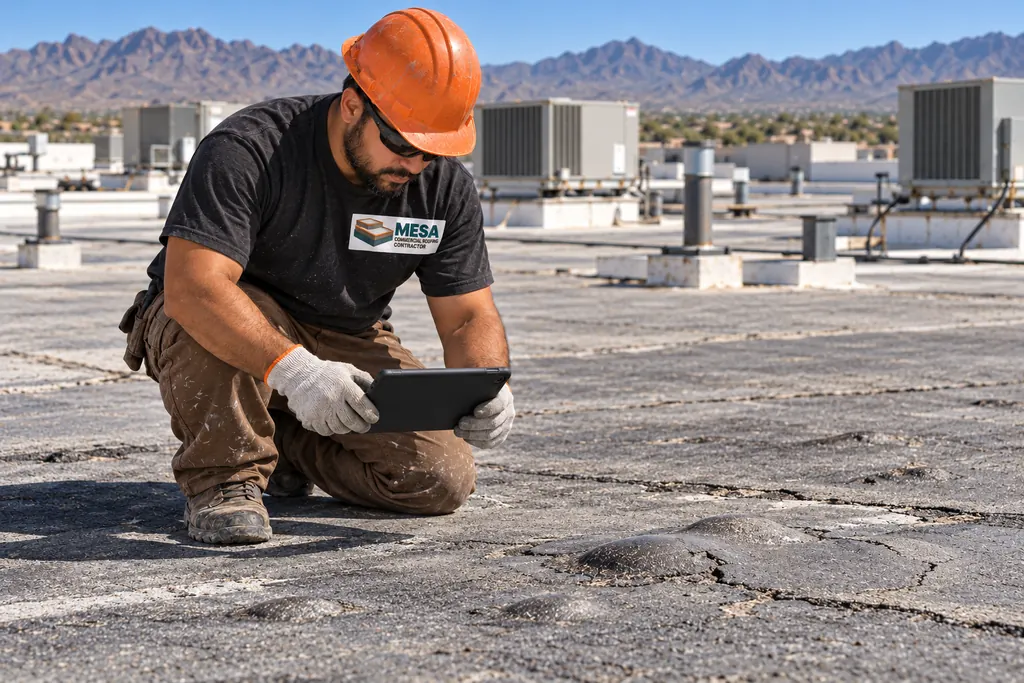
Roofer photographing a blistered area of an older flat roof with a tabletStep 1
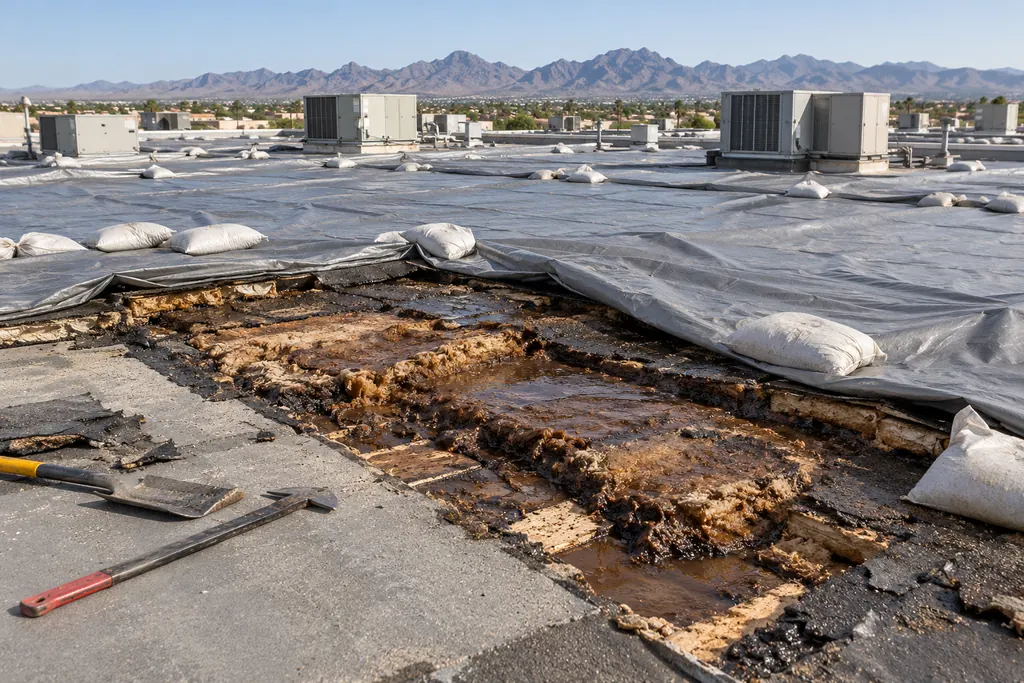
Section of old roofing cut open to show wet insulation, the rest under weighted tarpsStep 4
  1. Inspect Your Roof

    Walking the roof comes first: membrane, seams, flashing at curbs and walls, drains, edge metal, and the deck where we can see it. Photos and a moisture check show what is wet under the surface.

  2. Repair Or Replace?

    Isolated leaks at flashing or seams point to repair. Wet insulation across large areas, two roof layers already in place, or a rusted deck points to replacement, and we show you which signs we found.

  3. Which System Fits?

    Slope, rooftop traffic, and the roof already in place narrow the choice between TPO, EPDM, and metal. A white membrane suits cooled space; metal suits pitched shops and hangars.

  4. Staging Around Your Business

    Crews start early to stay ahead of afternoon heat, stage material away from entrances and loading docks, and dry in each opened roof section before leaving. HVAC shutdowns are set with your building manager.

  5. Walkthrough And Upkeep

    At the end, you walk the roof with us and see the details we changed. A spring and fall check, plus one after major wind or hail, keeps drains clear and seams closed.

Why It Matters

What The Right Roof System Does For A Mesa Building

These gains depend on matching the system to the building and installing the details carefully. The inspection tells us which ones apply to your roof.

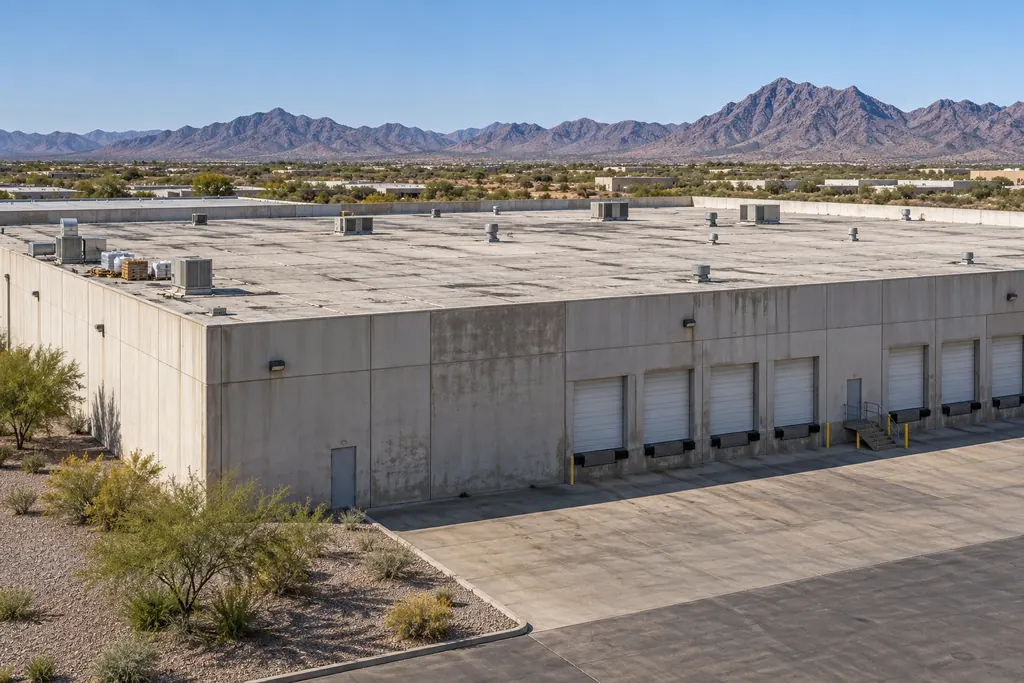
Industrial park warehouse with a large low-slope roof

A System Matched To The Building

Mesa's building stock runs from downtown masonry storefronts to Fiesta retail and the aviation and industrial buildings near Falcon Field and Gateway. Matching TPO, EPDM, or metal to the slope, the equipment, and the existing roof lets the new roof shed water and handle heat the way that building needs.

Less Heat Through The Roof

Reflective white membranes over cooled retail, office, and warehouse space can ease the cooling load. Results depend on insulation and equipment, so we make no savings promise.

Fewer Weak Points At Seams

Welded TPO seams and taped EPDM laps form continuous joints across the field of the roof, and new flashing at curbs and walls closes the spots where leaks usually start.

Work Done In Sections

Phased sections and daily dry-in let tenants, customers, and production keep moving below, with roof hatches, drains, and rooftop units kept reachable during the job.

Water Coming In After A Monsoon Storm?

Call and tell us where the water shows up inside and what sits above it on the roof, such as a unit, a drain, or a wall.

Call Us

Roof Conditions

What You See Inside, And What Causes It Up Top

Most roof calls start with something a tenant or manager notices indoors. Each pair links that sign to the roof detail we check first.

Stain Near A Rooftop Unit

Brown rings on ceiling tile below a unit tend to show up after the first big summer storm.

Curb Flashing Or Pitch Pockets

Dried sealant and split flashing at HVAC curbs and pipe penetrations let wind-driven rain under the membrane.

Leak That Moves Around

Drips that appear in a different spot each storm often trace back to water traveling under the sheet.

Wet Insulation

Water held in insulation board spreads sideways, so the leak inside can sit well away from the opening on the roof.

Musty Smell In Upper Offices

Damp odor in top-floor rooms with no visible stain can mean the roof is holding water above the ceiling.

Clogged Drains And Ponding

Dust and debris in drains and scuppers leave standing water that soaks through worn seams over a monsoon season.

Noise Or Flapping In Wind

Rattling overhead during gusts points to loose metal or a membrane edge that has started to lift.

Loose Edge Metal

Blown-back edge metal and lifted perimeter flashing open the roof edge to the next storm.

Rust Streaks On Interior Steel

Orange streaks on purlins or a metal ceiling deck show water has reached the structure from above.

Backed-Out Fasteners And Lap Rust

On metal roofs, heat movement loosens fasteners and opens panel laps, and rust grows at cut edges.

Repair Or Replace

Signs Your Roof Needs Repair Or Replacement

Our recommendation comes from what the inspection finds. These are the signs that push a Mesa roof one way or the other.

Repair Or Restore Fits

  • A few isolated leaks at flashing, seams, or penetrations
  • Dry deck and dry insulation under most of the roof
  • Membrane with surface wear but tight seams
  • Metal panels with loose fasteners over solid steel
  • One roof layer in place, with room for a recover

Replacement Fits

  • Wet insulation across large areas of the roof
  • Two roof layers already on the building
  • Rust or rot in the deck itself
  • Leaks in many spots that return after repairs
  • Membrane past its service life, cracked across the field

Service Areas

Mesa Districts And Nearby Towns We Roof

The map places each area by direction from central Mesa. Every area has its own page with the roof conditions and permit office that apply there.

Mesa commercial roofing service areas as hexagon cells: Downtown Mesa, Riverview, Fiesta, Falcon, Mesa Gateway, Apache Junction, Gold Canyon; schematic, not to scaleMesaDowntownMesaRiverviewFiestaDistrictFalconDistrictMesaGatewayApacheJunctionGoldCanyonFalcon FieldPhoenix-Mesa Gateway AirportUS 60Loop 202Loop 101NSchematic, not to scale
  1. Apache JunctionA separate city with its own building safety division, and older commercial roofs where we count existing layers before any recover.
  2. Gold CanyonUnincorporated Pinal County along US 60, so reroof permits run through Pinal County Building Safety.
  3. Downtown MesaMasonry storefronts behind parapets, historic district review on some buildings, and alley access for staging.
  4. Falcon DistrictAerospace and manufacturing roofs beside Falcon Field, where crane lifts get checked against FAA notice rules.
  5. Fiesta DistrictOlder retail shells and medical buildings converted to new uses, often with new rooftop units and curbs.
  6. Mesa Gateway AreaSecured campuses and large industrial buildings near Phoenix-Mesa Gateway Airport, with badge access and critical rooftop equipment.
  7. Mesa Riverview DistrictHotel, retail, and entertainment roofs near Sloan Park, scheduled around spring training crowds.

Questions

Commercial Roofing Contractor Questions From Mesa Owners

Short answers to the roof questions that come up most. Permit, tax, and utility answers sit with the full list of Mesa roofing questions.

Common Question

How Do Heat And Monsoon Season Wear Down A Mesa Roof?

Heat ages a roof in every month of the year, and the monsoon season, which the National Weather Service sets at June 15 through September 30, tests it with wind, dust, and heavy rain. After a hard summer we look for cracked sealant at pipes and curbs, blown-back edge metal, drains packed with dust, and worn surfacing on older roofs.

Do You Install New Roofs Or Only Repair Old Ones?

Both. We install new TPO, EPDM, and metal roofs, replace failed roofs down to the deck when the inspection calls for it, and repair leaks at seams, flashing, and penetrations on roofs with life left. On EPDM and metal roofs in fair shape, we also apply reflective coatings.

Can A New Roof Go Over The Old One?

Sometimes. A recover over one existing layer can work when the deck and insulation are dry and the attachment holds. A roof that already carries two layers, or holds wet insulation, needs a tear-off first. A moisture check during the inspection tells us which case you have.

What Should I Have Ready Before The Inspection?

Roof access, such as a hatch or a ladder point, and someone who can open it. Leak locations from inside help, along with past repair invoices or roof drawings. Names of the HVAC companies that service your units help too, since their curbs often need new flashing.

How Do You Handle Rooftop HVAC Units During Roof Work?

Units stay running wherever possible. When a curb needs new flashing or a unit has to be lifted, we set the shutdown window with your building manager and the HVAC contractor, and we keep odor-producing work away from fresh-air intakes while people are inside.

Does A White Roof Lower Cooling Costs In Mesa?

It can help. A white TPO membrane reflects much of the summer sun, which can ease the cooling load on the floors below. How much depends on insulation, ceiling height, and the HVAC equipment, so we treat it as a benefit to weigh, never as a promised dollar figure.

Get A Free Estimate For Your Mesa Roof

Enter the roof size, type, and condition for a ballpark figure, or call to set up an inspection.

Call Us (623) 310-0175