Start With The Roof And Its Use
A roofing decision should account for the existing assembly and the way the property operates. Equipment service, access and occupied spaces can affect the project. Tell us about the conditions at your building rather than relying on assumptions about the surrounding area.
A roof with several sections may have different materials or repair histories. We assess the relevant areas and transitions so the scope matches what is actually present. One sound section does not establish that every section is suitable to retain.
Review Equipment-Related Details
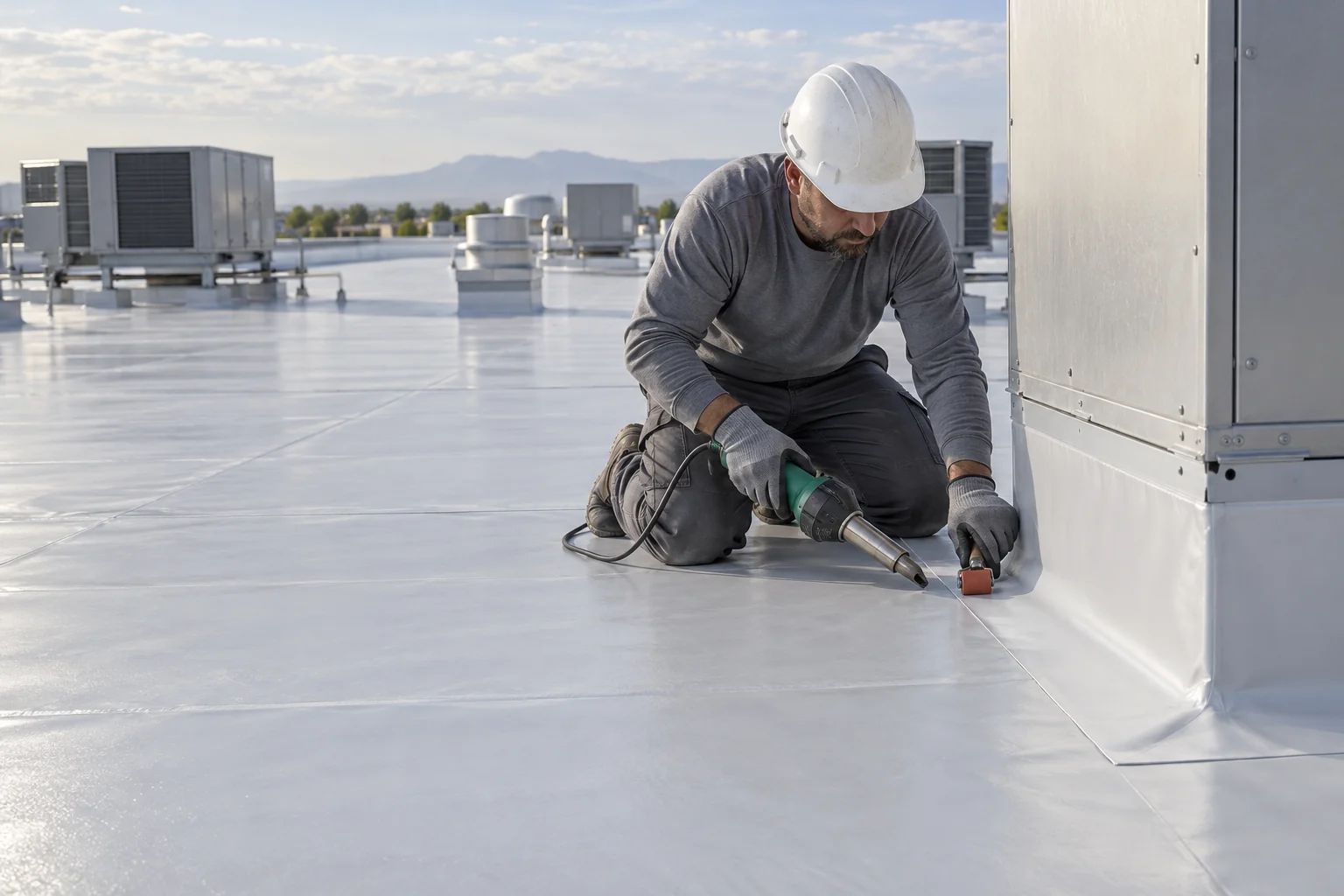
Curbs, penetrations and supports interrupt the roof field and can need different work from the broad surface. Recent equipment service may provide useful context when investigating a leak. A problem near a unit should be assessed before it is assumed to be only a membrane defect.
Planned equipment changes should be coordinated with roofing. A properly detailed new opening protects the completed assembly better than an improvised penetration after the roof work is finished. Future access routes also deserve consideration.
Match Repairs To The Material
TPO and PVC require compatible thermoplastic membrane work; EPDM uses its own compatible seam and repair methods. Metal roofing requires attention to panels, laps and attachment. The materials should not be treated as interchangeable because they serve the same building function.
Old patches and weathered surfaces can affect preparation. A new repair needs a sound connection to appropriate material. Covering loose or unsuitable repairs may leave a weak base under the new work.
Assess Local And Concealed Damage
A puncture or open flashing may be repairable when the adjacent roof is serviceable. The assessment considers both the visible defect and possible effects beneath it. Water can travel before appearing inside, and the size of a stain does not determine the repair boundary.
Where moisture is suspected, further investigation can help identify material requiring removal. Local damage does not automatically mean complete replacement, but a surface patch should not be expected to restore wet or unstable components.
Consider A Broader Roofing Scope
Restoration can be useful for a compatible sound assembly after repairs and preparation. It is not suitable merely because a coating can be applied. Adhesion, drainage and retained material condition all influence the decision.
Replacement may be appropriate where deterioration is extensive or the roof cannot support the intended work. The recommendation should explain those conditions rather than assume the whole building needs a new roof whenever a leak occurs.
Address Drainage As Part Of Assessment
The roof surface directs water toward outlets, and the details around those outlets form part of the waterproofing. A blockage, damaged connection and low area are distinct concerns. Each may require a different response.
A material’s water resistance does not eliminate the need for drainage evaluation. If retained water is a concern, describe where and when it appears. The actual cause determines whether the work involves maintenance, a detail repair or a larger roofing change.
Questions Before You Request Work
Can the roof material be identified during assessment? Yes, and existing information can help. Does a recurring leak prove the roof has failed everywhere? No; the source and extent need investigation. Can pricing be based on square footage only? Not meaningfully when repairs, material and access are still unknown.
The request can begin with ordinary observations. Include the commercial address, current concern and relevant access restrictions. Do not climb onto an unfamiliar roof to collect information; appropriate access can be arranged for inspection.
Evaluate The Surface Around Old Patches
An old patch is evidence of previous work, not proof that the current problem has the same cause. The repair may remain sound while a nearby detail fails, or its edge may have loosened and become a new entry point. The roof assessment should distinguish those conditions.
Compatibility also matters. Different repair products can behave differently on the original membrane or metal finish. A new scope may need to remove unsuitable material before a reliable connection can be established. Covering it again can preserve a weak layer within the assembly.
If the roof has a history of repairs, identify the areas and symptoms you know about. There is no need to reconstruct every past product choice before requesting an assessment. The inspection can determine where material identification and further investigation are necessary.
This condition-based approach supports a proportionate decision. A patched roof is not automatically beyond repair, and a clean-looking section is not automatically ready for restoration. The relevant question is whether the retained material can support the work being proposed for that section.
Get An Estimate
Use the commercial roofing request form for your Superstition Springs property in Mesa. The assessment establishes the system-specific work and the condition-based scope. No automated coating price is substituted for TPO, EPDM, PVC or metal roofing work.