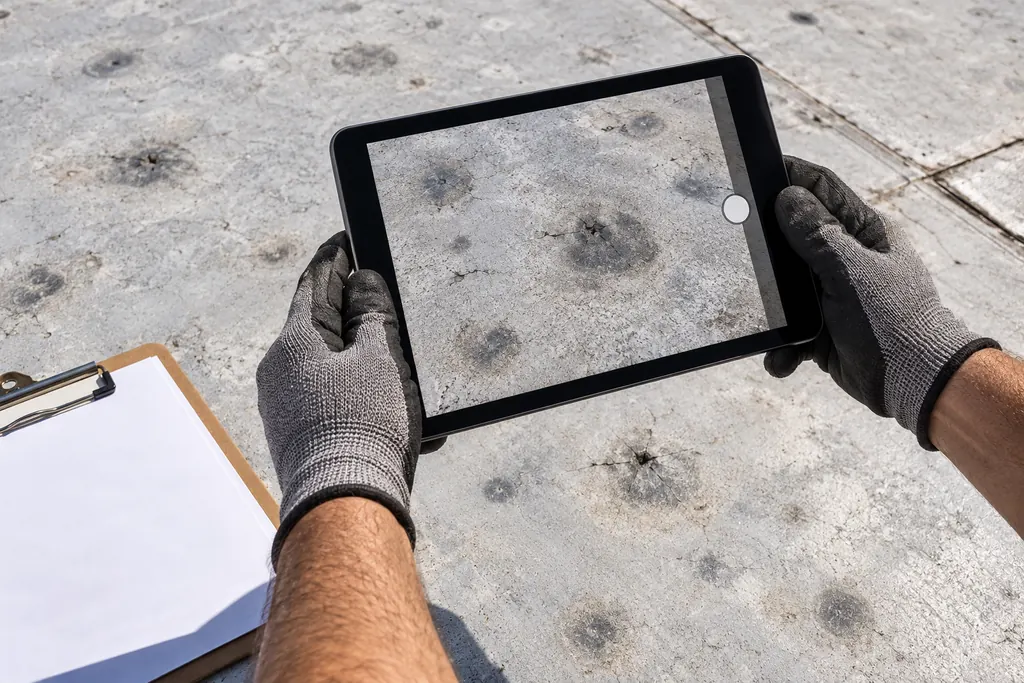
Tablet photographing hail bruises on a roof membrane

Mesa Commercial Roofing Questions

Straight answers to the commercial roofing questions Mesa owners ask about TPO, EPDM, metal, and industrial roofs, permits, taxes, and upkeep.

Roofing In Mesa

Why Mesa Commercial Roofing Needs Local Answers

Mesa roofs work hard. Long stretches of triple-digit heat bake membranes and sealants, and summer monsoon storms bring sudden wind, dust, and heavy rain onto flat decks.

The city mixes older downtown storefronts, retail centers along the Fiesta District corridor, and large industrial and aviation buildings near Falcon Field and the Gateway area, so the right roof system varies a lot from one property to the next.

Roof Systems And Fit

Is TPO a good roof for flat commercial buildings in Mesa?

Yes, for many low-slope buildings it is a strong choice. A white TPO membrane reflects much of the summer sun, which can ease the cooling load on retail, office, and warehouse space.

As a TPO roofing contractor, we look closely at seam welds and flashing at rooftop HVAC curbs, because those details take the most heat and foot traffic. We also check the insulation underneath, since wet or crushed board shortens a new membrane's life.

When does EPDM make more sense than TPO for a Mesa property?

EPDM fits well where a roof sees movement, odd penetrations, or an existing rubber system in fair shape. It is flexible and has a long track record on low-slope decks.

Standard black EPDM absorbs heat, which matters under the Mesa sun. Our EPDM roofing contractor work often pairs the membrane with a reflective coating or a white-surfaced sheet. That approach can suit older strip centers and flex buildings where a full tear-off is not yet needed.

Do you handle large industrial and warehouse roofs?

Yes. Industrial roofing covers distribution centers, manufacturing plants, and hangar-style buildings, including the larger facilities near Falcon Field and the Mesa Gateway area.

These roofs bring their own concerns:

  • Wide spans with many drains and scuppers to keep clear
  • Exhaust fans, vents, and process equipment that need tight flashing
  • Safety planning for crews working near skylights and roof edges
  • Phased sections so production lines keep running

Should I choose a metal roof for my commercial building in Mesa?

Metal works well on pitched commercial roofs, shop buildings, and many industrial structures. It sheds monsoon rain fast and handles heat without softening.

As a commercial metal roofing contractor, we watch for loose fasteners, failed sealant at laps, and rust at cut edges. Expansion and contraction from hot days and cooler nights work fasteners loose over time. Restoration with fastener replacement and a coating can extend an aging metal roof.

Which roof system fits which type of Mesa building?

The best match depends on slope, use, and what is on the roof now. We use this general guide as a starting point during an inspection.

Building typeCommon fitWhy it works
Retail and office (low slope)TPOReflective, welded seams, good for HVAC-heavy roofs
Older strip centers and flex spaceEPDM or coated EPDMFlexible, can often be restored rather than torn off
Warehouses and plantsTPO or metalCovers large spans; durable with proper drainage
Shops, hangars, pitched roofsMetalSheds water fast, long service life
Downtown masonry buildingsTPO or EPDM behind parapetsFits tight parapet details and tricky access

Every building is different, so treat these pairings as a guide rather than a rule.

Roof Condition And Climate

How does Mesa's heat and monsoon season affect a commercial roof?

Heat ages roofs year-round, and monsoon storms test them every summer. The National Weather Service sets Arizona's monsoon season as June 15 through September 30.

What we commonly see after a hard summer:

  • Dried, cracked sealant around pipes, curbs, and pitch pockets
  • Blown-back edge metal and loose flashing after strong gusts
  • Ponding water where drains or scuppers clogged with dust and debris
  • Surface wear on older coatings and granulated cap sheets

Freezes are uncommon in town, though cooler nights still cause daily expansion and contraction. The NWS Phoenix office posts storm warnings for the Mesa area.

Should I repair or replace my Mesa commercial roof?

If the deck and insulation are mostly dry and the membrane still has life, repair or restoration usually makes sense. Widespread wet insulation, repeated leaks in many spots, or a membrane past its service life point toward replacement.

SignUsually points to
A few isolated leaks at flashing or seamsRepair
Sound membrane with surface wearCoating or restoration
Wet insulation across large areasReplacement
Two roof layers already in placeTear-off and replacement
Deck rust or rotReplacement with deck repair

An infrared or core-cut moisture check helps settle the question before money is spent.

How long do commercial roofs last in Mesa's climate?

Service life varies with installation quality, maintenance, and sun exposure. Treat these ranges as typical rather than promised.

SystemTypical service life
TPOAbout 20 to 30 years
EPDMAbout 25 to 30 years
Metal40 years or more

Intense UV can shorten the low end, while regular upkeep tends to push a roof toward the high end.

How often should a commercial roof in Mesa be inspected?

Twice a year is a good baseline: once in spring before monsoon season and once in fall after it. Add a check after any major wind or hail event.

Routine upkeep covers clearing drains and scuppers, resealing penetrations, fixing small membrane damage, and checking edge metal. Catching a split seam early costs far less than replacing soaked insulation later.

Not Sure Which Answer Fits Your Roof?

Call and describe the building, the roof type if you know it, and where water or wear shows up. We will tell you what the inspection should cover.

Call Us

Working Around Your Business

Can you work on our roof without shutting down the business?

In most cases, yes. We plan the work in sections so tenants, customers, and production keep moving.

Typical steps include:

  • Early-morning starts to avoid peak afternoon heat
  • Staging materials away from entrances and loading docks
  • Coordinating HVAC shutdowns and odor-producing work with building managers
  • Daily dry-in so the building stays protected overnight and ahead of storms

How do I get started with a commercial roof project?

Call us or request a free estimate to schedule a commercial roof inspection. The visit gives you a clear picture of the roof's condition before any decision.

During the inspection we check:

  • Membrane, seams, and surface wear
  • Flashing at walls, curbs, and penetrations
  • Drains, scuppers, and signs of ponding
  • Moisture in the insulation below
  • Edge metal, parapets, and coping
  • Deck condition where visible

You then get our findings and recommended options for repair, restoration, or replacement.

Permits, Taxes, And Local Rules

Do I need a permit to reroof a commercial building in Mesa or nearby?

Commercial reroofing often needs a permit, and the rules come from whoever has building authority at the address. Districts inside Mesa follow City of Mesa rules; nearby communities have their own.

LocationBuilding authorityWhere to check
MesaCity of Mesa Development ServicesBuilding Permit & Plan Review
Downtown MesaCity of Mesa Development ServicesSame City of Mesa office
Falcon DistrictCity of Mesa Development ServicesSame City of Mesa office
Fiesta DistrictCity of Mesa Development ServicesSame City of Mesa office
Mesa Gateway AreaCity of Mesa Development ServicesSame City of Mesa office
Mesa Riverview DistrictCity of Mesa Development ServicesSame City of Mesa office
Apache JunctionCity of Apache JunctionCity building safety office
Gold Canyon (unincorporated)Pinal County Building SafetyPinal County Building Safety

Permit triggers and fees change, so we confirm requirements with the right office before work starts.

Are there historic review rules for roofs near downtown Mesa?

Possibly. Mesa has eight locally designated historic districts, several close to downtown, plus individually listed landmarks.

Changes to locally designated historic resources go through the city's Certificate of Appropriateness review. Visible roof changes on these buildings may need that review, so we check with the Mesa Historic Preservation Office before choosing materials.

Can a new commercial roof qualify for Section 179 expensing?

It can. Under federal rules, roofs on existing nonresidential buildings are among the improvements eligible for the Section 179 deduction, which lets owners expense the cost rather than depreciating it over decades.

For tax years beginning in 2026, the deduction limit is $2,560,000, per IRS Publication 946. Residential rental property does not qualify. Tax situations differ, so talk with your CPA before counting on the deduction.

Who supplies electricity in Mesa, and are there cool roof incentives?

Most of Mesa is served by SRP. The City of Mesa runs its own electric utility for an area of about 5.5 square miles centered on downtown.

Either utility may offer efficiency programs at a given time, but programs and rules change often. We never promise a rebate. When a program does apply, it often requires a product rated by the Cool Roof Rating Council, so we confirm current terms with your utility before ordering materials.

How can I verify a roofing contractor's license in Arizona?

Use the Arizona Registrar of Contractors. Its online lookup shows license status, classification, and complaint history.

Check that the license covers commercial roofing work and is active before any work begins on your building.

Still Have Roof Questions?

Get a ballpark figure for your roof in a few steps, or call and ask about your building directly.

Call Us (623) 310-0175