Drip Line Under A Unit
Water spots under one rooftop unit after storms point straight to its curb.
Split Curb Flashing
Flashing welded around an HVAC curb takes heat and foot traffic, and its corners split first.

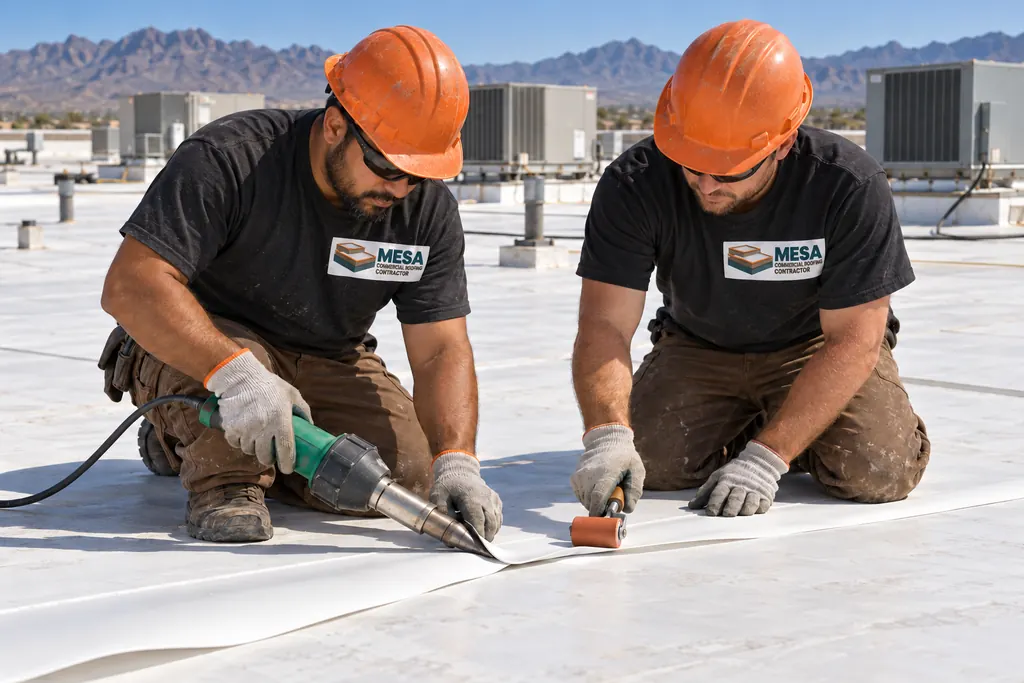
As a TPO roofing contractor, we install and repair white TPO roofs on Mesa retail, office, and warehouse buildings, welding every seam and flashing every curb before a section closes.
Fit
TPO fits most low-slope commercial roofs in Mesa. The right column lists the conditions where another system, or more repair, comes first.
TPO Roof Conditions
Most TPO trouble starts at seams, curbs, and edges. Each pair shows the sign indoors and the detail we check on the roof.
Water spots under one rooftop unit after storms point straight to its curb.
Flashing welded around an HVAC curb takes heat and foot traffic, and its corners split first.
Stains that grow along a ceiling grid line follow a seam or a fastener row above.
A seam welded too cool can peel at the edge, which a probe test along each lap finds.
Facility staff notice the roof feels spongy near drains or units.
Foot traffic and trapped water crush insulation board, which shortens the life of the TPO above it.
Billowing or fluttering overhead in gusts means part of the membrane has lost attachment.
Plates at seams back out when the deck or insulation below has softened.
Light residue below scuppers after rain points to an older, weathered sheet.
Standing water around a drain and years of sun thin the membrane where it laps the drain bowl.
Options
Four ways to handle a TPO roof, matched to what the inspection finds.
| Option | When It Fits | What The Work Involves |
|---|---|---|
| Targeted repair | Isolated leaks at curbs, seams, or penetrations on a roof with life left | Cleaning, re-welding open laps, new patches and curb flashing |
| Section replacement | Wet insulation confined to one area, such as around a drain or unit | Cut out the wet area, replace insulation and cover board, weld new TPO in |
| Recover | One existing layer, dry insulation, and a deck that holds fasteners | New cover board and TPO fastened over the old roof |
| Tear-off and replace | Wet insulation across large areas, two layers, or deck damage | Remove to the deck, repair the deck, new insulation and TPO |
Why TPO
These gains hold when the deck is dry and the details are welded right. The inspection confirms which ones apply to your roof.
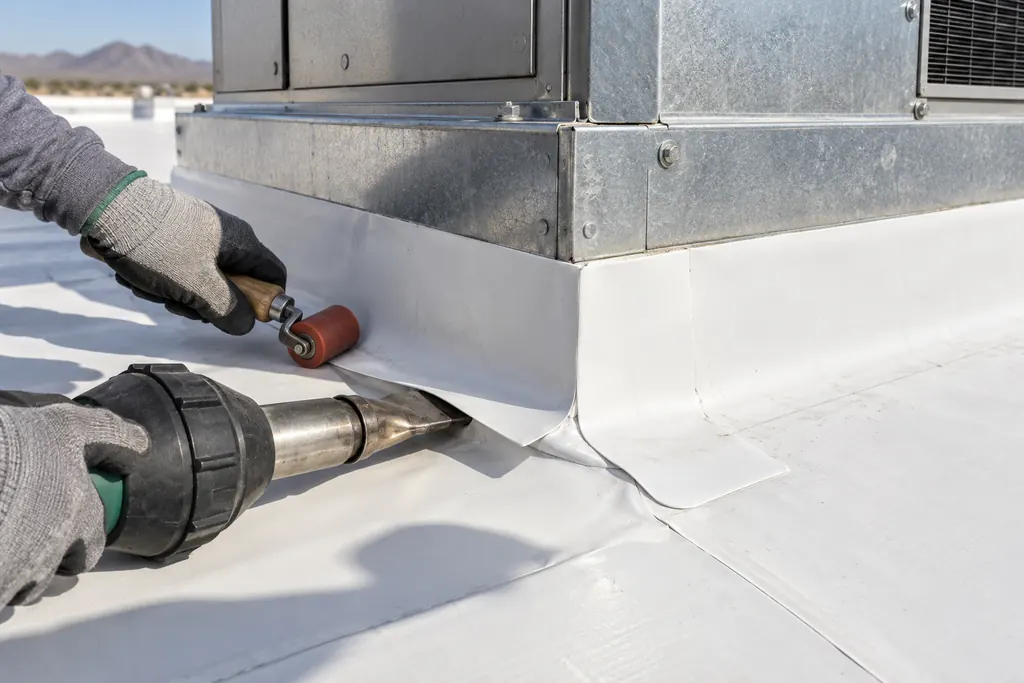
Hot-air welding fuses TPO laps into one continuous sheet, with no adhesive to dry out in summer heat. The same welding closes the flashing around HVAC curbs, which is where most Mesa TPO leaks begin.
A white membrane reflects much of the summer sun, which can ease the cooling load on the space under the roof deck.
Tear-offs and recovers let us add insulation board, and tapered board can slope flat areas toward the drains.
Later damage at a curb, or a puncture from foot traffic, is patched by welding new TPO to the old sheet once the surface is cleaned.
Call with the location of the leak inside and the closest rooftop unit or drain, so the inspection starts at the right spot.
Call UsTPO Work Sequence
Five decisions move a TPO job from the first walk to the final weld check.
 Step 1
 Step 4
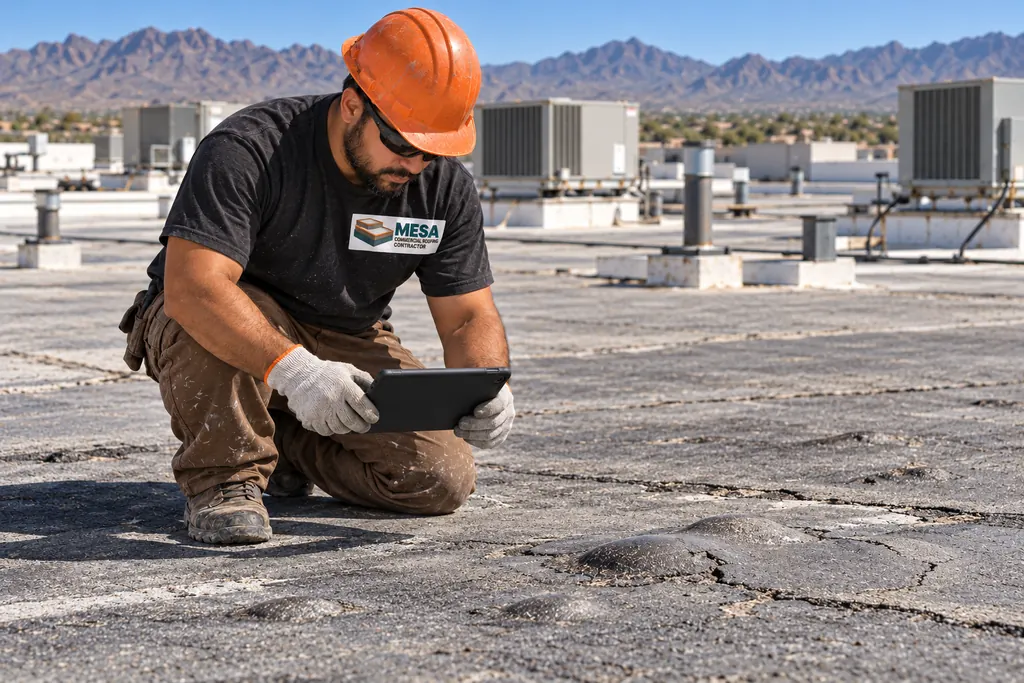
Probing every seam with a hand tool shows where welds have let go, and a moisture survey maps wet insulation. We photograph curbs, drains, and edges so you see what we see.
Dry insulation and tight seams across most of the roof favor repair or a recover. Widespread wet board, or a second existing layer, means taking the roof down to the deck.
Wind exposure and the deck type set the fastening pattern for plates and board. On a tear-off, this is also the point to add insulation or tapered board toward drains.
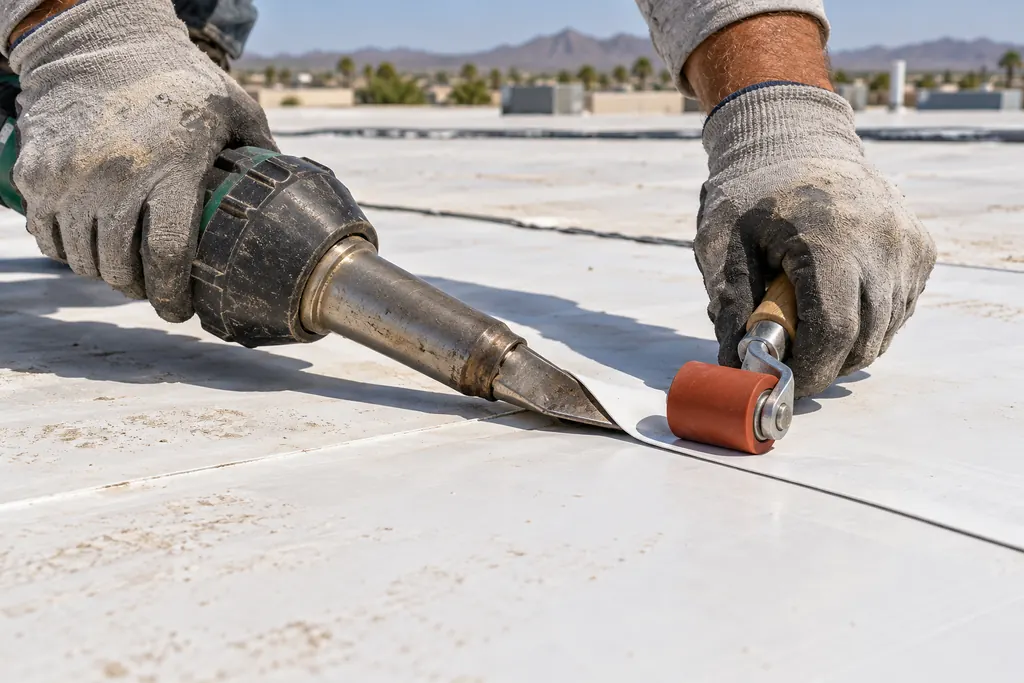
Sheets go down in sections, each seam welded and probed before the crew moves on. Curbs, pipes, and walls get welded flashing, and opened sections are dried in each evening.
Every seam gets a last probe test, and we walk the roof with you. Clearing drains and checking curbs each spring and fall protects the new membrane.
Related Services
Two other systems come up often on the same buildings as TPO.
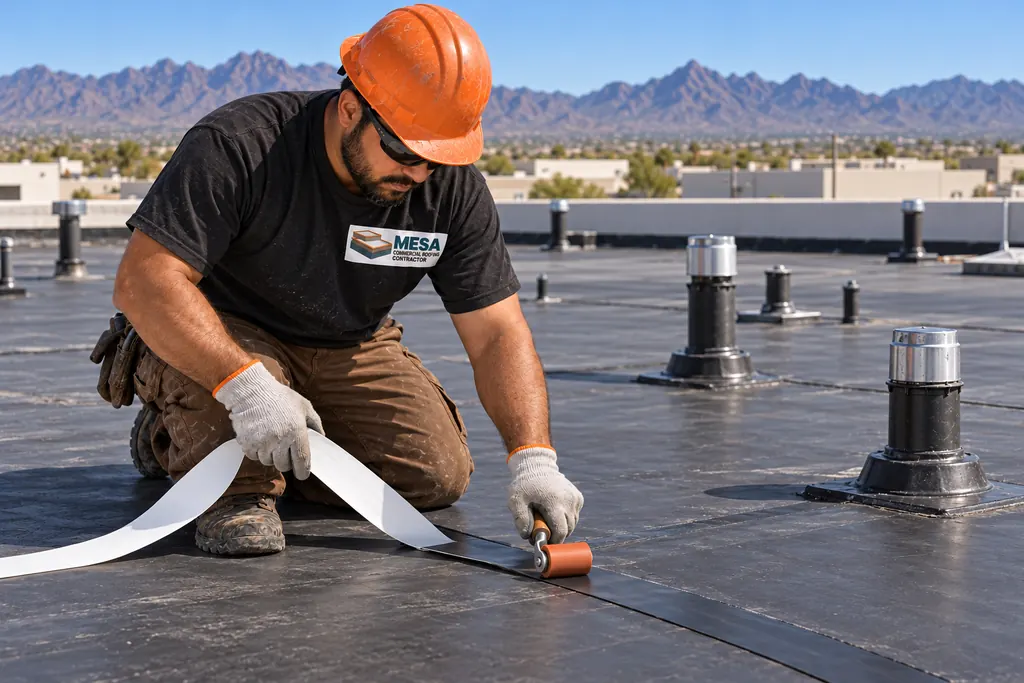
When the existing roof is rubber with life left, seam repair and a reflective coating can come before a TPO tear-off, so we compare both.
EPDM roofing in Mesa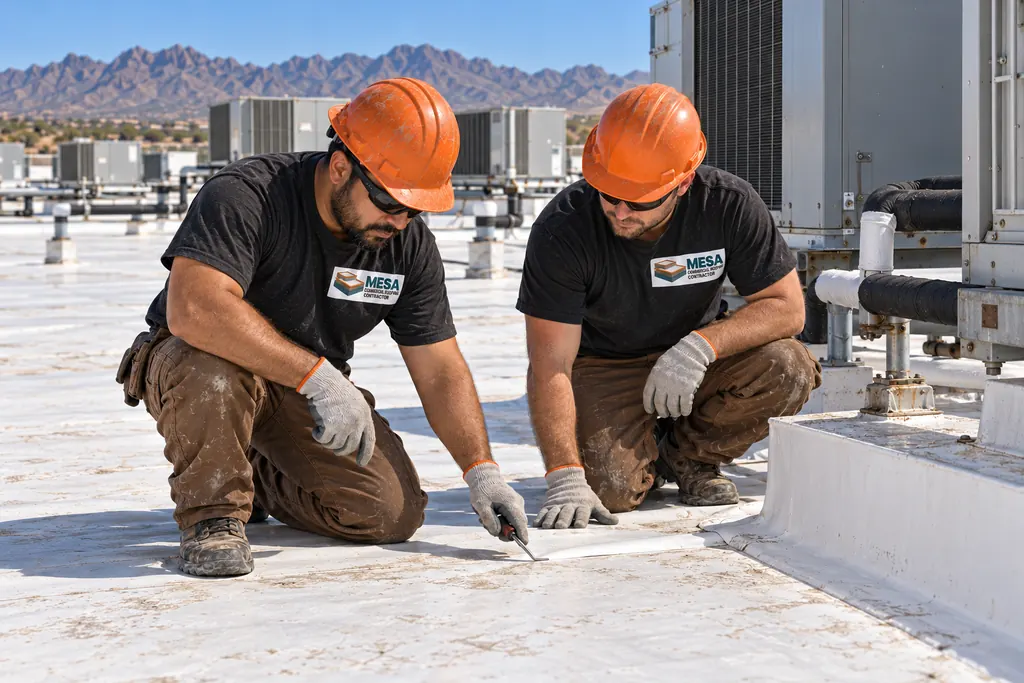
Plants and distribution buildings often get TPO too, laid with walk pads, lifelines, and phased sections that keep production running.
Industrial roofing in MesaTPO Questions
Answers about TPO roofs on Mesa commercial buildings.
Common Question
For many low-slope buildings, yes. The white sheet reflects much of the summer sun, which helps over retail, office, and warehouse space.
Its weak points are the seam welds and the flashing at rooftop HVAC curbs, which take the most heat and foot traffic, so we check those closely, along with the insulation below, since wet or crushed board shortens a new membrane’s life.
Common sheets run 45, 60, and 80 mil. A thicker sheet carries more weathering material above the reinforcing scrim, which helps on roofs with heavy foot traffic around units. We match thickness to the roof’s traffic and to the manufacturer’s system requirements for that building.
A blunt probe drawn along the edge of each weld finds spots where the sheets did not fuse. Those voids look closed from above but let water travel into the lap. We probe new seams before leaving a section, and we probe existing seams during every inspection.
Sometimes. Curbs too short for the new insulation, or rusted at the base, need raising or repair, and the unit is lifted while that happens. Most units stay in place while new flashing is welded up the curb. We plan any lift with your HVAC contractor.
Both methods work. Fastened systems use plates and screws in the seams and fit most steel decks. Adhered systems glue the sheet to the board, which removes fastener rows and helps on some recovers and wind-exposed edges. Deck type, wind exposure, and the manufacturer’s requirements decide which one we use.
Yes, over time. Service techs walking the same path to a unit crush insulation and scuff the sheet. Walk pads welded along those paths spread the load, and we lay them out during the install so HVAC crews have a marked route.
Dust settles on every roof here, and a dirty white sheet reflects less sun. Rinsing with low-pressure water and a mild cleaner during the spring check brings back much of the surface, and it gives us a clear look at the seams at the same visit.
Share the roof size and condition for a ballpark range, or call to set up a seam and moisture inspection.
Roof Question
Leave a name and number, or call (623) 310-0175 now.